China's Hold on Congolese Cobalt
 Peter Zeihan
5 min
We must learn to get by with less because business as usual for tech advancement will simply not fly. More likely, the business as usual of tech advancement that we become used to is simply not going to fly.
Chapters
-
0:00
The Critical Role of Cobalt
Cobalt is essential for stable battery chemistry in phones and electric vehicles, as lithium alone degrades too quickly.
-
0:33
China's Monopoly on Congo
Over half of global production comes from the Democratic Republic of Congo, where China controls mining camps like a slave state. Foreign forces cannot easily stabilize Congo because the capital lacks a functional port and the interior is inaccessible.
-
2:20
Environmental Unsuitability for Westerners
White people do not thrive in the hot jungle environment required to stabilize the region after China collapses. Europe and North America will likely partner with local authorities at arm's length rather than intervene directly. Global tech advancement must change because future flows of cobalt will not meet current needs. Tantalum, another critical material also found in Congo, faces similar supply risks and production issues. Tungsten from Myanmar offers a better path because it has less market concentration and a stronger central government.
-
4:25
The Final Verdict
We must learn to get by with less because business as usual for tech advancement will simply not fly.
Key points
- 0:00
You really do need the cobalt in order to stabilize the system.
- 0:33
Over half of the world's production comes from the Democratic Republic of Congo.
- 0:33
The Chinese basically run it like a slave state that actually makes the Belgian imperials of old blush.
- 0:33
The Congo River is only navigable a few miles from the coast.
- 2:20
And to be perfectly blunt, white people don't do well in that sort of environment.
- 2:20
So we would probably be talking about some sort of at-arm's length management system.
- 2:20
That's going to change the technological curve of where we're going.
- 2:20
Unfortunately, one of the other ones is something called tantalum, which is used for similar purposes.
- 2:20
But in a post-Chinese environment, you're probably going to have a stronger central government in Myanmar.
- 4:25
More likely, the business as usual of tech advancement that we become used to is simply not going to fly.
On the map
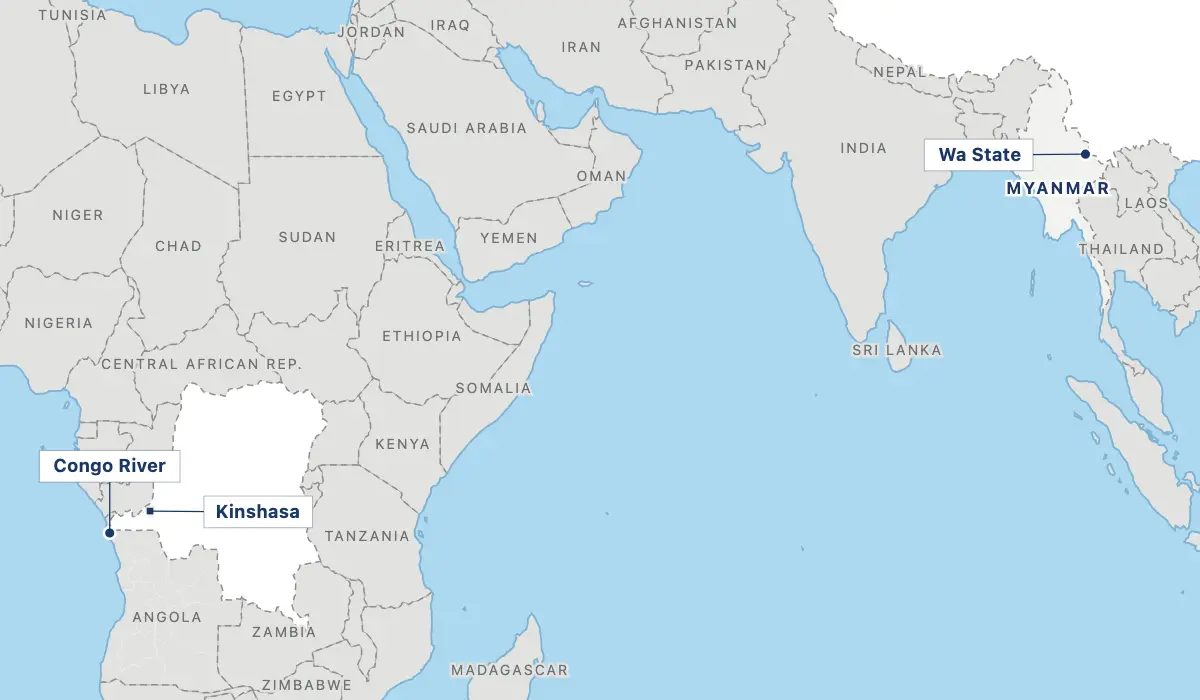
Who and where
Places · 10
- Democratic Republic of the Congo 8
- People's Republic of China 10
- United States 1
- Myanmar 4
- Kinshasa 3
- Wa State 2
- Congo River 1
- North America 1
- Belgium 1
- Europe 1
Related episodes
 25:39
China Just Lost Its Best Chokehold On The Global Economy
 Paul J. Warburg
China's long-term strategic hold on the global economy through rare earth metals is ending because its heavy rare earth supply is finite while other nations have untapped reserves. The geopolitical landscape is reversing as China faces a genuine supply shortage of heavy rare earths while the world develops alternatives.
 28:31
Something Utterly Bizarre Just Happened in China
Paul J. Warburg
China's technological dominance masks a fundamental weakness caused by massive debt and a lack of domestic energy resources. In the net, in China, what we see is a house of cards that is reported on as if it were a house of steel.
 3:04
Project Vault Doesn't Solve the Mineral Problem
Peter Zeihan
Project Vault fails to solve the mineral problem because most critical materials processing is done in China. Without diplomacy to secure resources from Canada, Australia, and Brazil, the initiative remains a rounding error.
 21:55
China’s Biggest Problem Just Got SO MUCH Worse
Paul J. Warburg
China's water shortage puts them at a structural disadvantage against AI competitors and increases their incentive to provoke water conflicts. China's only real solution is geopolitical, potentially involving damming rivers or bringing water from Russia.
 19:38
China Just Got Some Terrible News
Paul J. Warburg
China is afraid of losing Western markets and will not use coercion tactics that threaten its economic survival. Today, China, which traditionally has been more adversarial, finally got a really good check put in place on them.

AI-generated summary · model qwen3.5:9b-12k · prompt version whole-3.window-7.combine-10.s-f4be8e ·
video id HAjjFACnFpA ·
Watch on YouTube