Back to the Glory Days of the Spice Trade
 Peter Zeihan
4 min
The technologies of globalization are failing, and the system that has allowed the whole world to go wherever it wants and access any particle are breaking down. We're probably going to be going into a world where the single biggest impact is going to be a collapse in what we considered manufactured goods trade.
Chapters
-
0:00
The Historical Spice Trade
Explains how the spice trade connected East Asia to Western Europe via Central Asia and the Ottoman Empire before Portuguese deep-water navigation disrupted it. Argues that current globalization technologies are failing and deep-water navigation alone cannot protect global sea lanes.
-
2:23
The Shift to Regionalized Trade
Predicts a return to sequestered trade where most commerce becomes regionalized or localized due to an inability to protect global routes. States that the model of manufactured goods requiring thousands of supply chain steps among many countries will collapse.
Key points
- 0:00
Before roughly 1400-1500, the world was separated into dozens of little micro economies.
- 0:00
Spices and silks originated in East Asia or Southeast Asia.
- 0:00
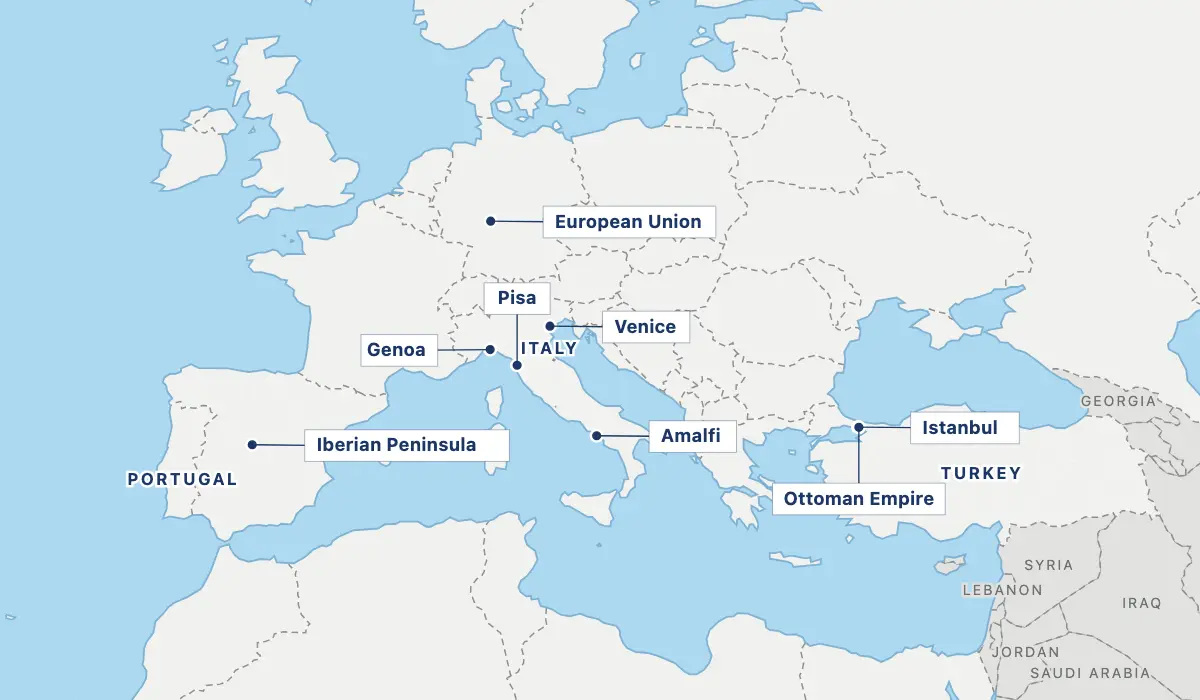
Routes funneled through Central Asia to the Ottoman Empire in Istanbul.
- 0:00
Italian cities like Venice became gateways for products into Western Europe.
- 0:00
Italian city-states made mad money on the spice trade at the expense of Christian Europe.
- 0:00
Portugal figured out deep water navigation to sail out of sight of land.
- 0:00
Istanbul and Italian city-states went from being the wealthiest parts of the world to being cut off.
- 2:23
No single country can protect global trade routes on a global basis.
- 2:23
Most trade will become much more regionalized or even localized.
- 2:23
The biggest impact will be a collapse in manufactured goods trade.
- 2:23
Thousands of products requiring multiple supply chain steps will cease production.
On the map
Who and where
Places · 19
- Istanbul 3
- Western Europe 2
- Europe 2
- Amalfi 1
- Genoa 1
- Iberian Peninsula 1
- Ottoman Empire 1
- Pisa 1
- Venice 1
- East Asia 1
- Africa 1
- Central Asia 1
- Southeast Asia 1
- India 1
- Italy 3
- Turkey 2
- Portugal 1
- United States 2
- European Union 1
Related episodes
 3:00
The Turn: Demographics Meet Deglobalization
Peter Zeihan
The United States will surrender its position in the Eastern Hemisphere before the end of the Trump administration. Everyone will soon notice major disruptions in agriculture due to these changing global mechanics.

The End of the WTO
Peter Zeihan
The collapse of the WTO will trigger decades of conflict among states and within states as existing models fail. The collapse of the WTO will trigger decades of conflict among states and within states as existing models fail.
How Was Trump's Trip to Asia?
Peter Zeihan
Trade relationships with aging nations must eventually go to zero regardless of political reasons. The back and forth and the ebb and flow continues without final resolution.

Why I'm Bullish on Southeast Asia
Peter Zeihan
Southeast Asia is well positioned to take advantage of both regional trade and demographics. These countries look good on their own.
What's Wrong with the EU-India Trade Deal?
Peter Zeihan
There is no free trade on a transcontinental or trans-oceanic basis unless there's freedom of the seas and global rule of law. Countries must develop an internal regional structure to support trade rather than seeking global deals.
AI-generated summary · model qwen3.5:9b-12k · prompt version whole-3.window-7.combine-10.s-f4be8e ·
video id ZpdSO-boHq4 ·
Watch on YouTube