What’s Next for Iraq?
 Peter Zeihan
6 min
The withdrawal of US troops leaves Iraq unstable, risking Iranian dominance in the south or a return to Sunni rule. Peace in the region is unlikely as history suggests Sunnis will rise again if the system becomes unmoored.
-
 Saddam Hussein
Chapters
-
0:00
The Artificial Structure of Iraq
Iraq is an artificial state created by colonialism containing three distinct regions with conflicting demographics and resources. The country consists of Shia Arabs in the south, Kurds in the north, and Sunni Arabs in the middle.
-
1:45
Historical Power Dynamics
The Sunnis historically held total control under Saddam Hussein while enslaving or persecuting the other two groups.
-
3:28
Current Instability and Future Risks
With US withdrawal, Iran will likely destabilize the south while Sunnis may rise to power again.
Key points
- 0:00
Iraq is an artificial country created by colonialism after World War II.
- 0:00
The south contains the majority Shia population with massive oil fields.
- 0:00
The north is Kurdistan, a region split among rival families with difficult oil access.
- 0:00
Collective peak production in the south and north reached four to five million barrels per day.
- 1:45
The middle region consists of Sunnis who make up at most 20% of the population.
- 1:45
The Sunnis are the most united group due to their small size and lack of economic resources.
- 1:45
The Sunnis previously controlled everything while enslaving or persecuting the Shia and Kurds.
- 3:28
The current prime minister has no backing except for the United States.
- 3:28
Iranian-backed militias in the south can now overthrow the government and attack other regions.
- 3:28
The Kurds face renewed threats from outside forces now that American protection is gone.
- 3:28
History suggests Sunnis will emerge on top if the system becomes unmoored and foreigners leave.
On the map
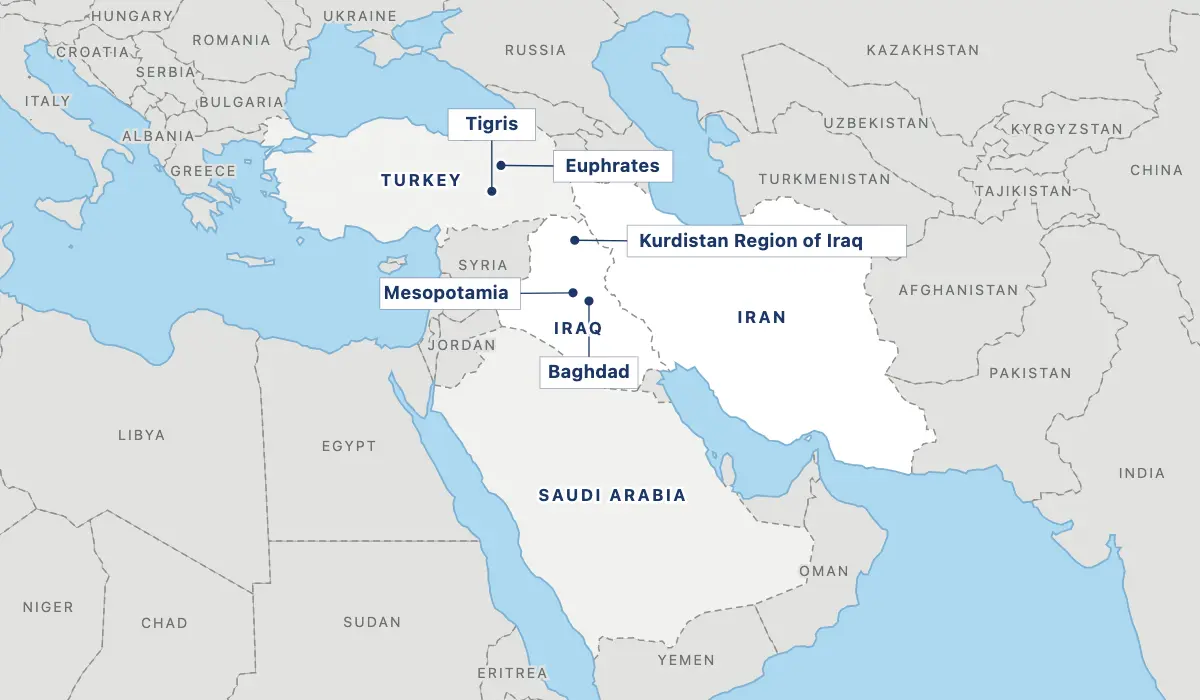
Who and where
Places · 10
- Iraq 10
- Kurdistan Region of Iraq 3
- Iran 3
- Euphrates 1
- Mesopotamia 1
- Tigris 1
- Baghdad 1
- United States 5
- Turkey 1
- Saudi Arabia 1
People · 1
-
Saddam Hussein 1
Iraqi politician and revolutionary, president of Iraq from 1979 to 2003
Photo 1
1. Photo: Unknown author Unknown author, Public domain, via Wikimedia Commons · Wikidata · redrawn in our house style (Saddam Hussein)
Related episodes
 5:53
Should the U.S. Military Invade Yemen?
Peter Zeihan
The United States faces an ugly choice between a difficult military occupation or accepting Iranian control over Gulf energy. A military solution is too involved to recommend, leaving the only viable option as a political deal with Iran.
So You Want to Take Iran's Oil…
Peter Zeihan
There is no good way to take other countries' oil. We will be in occupation in the Middle East just like we were for the bulk of the last 25 years.

Iraq, Oil, and a Break for Chevron
Peter Zeihan
American oil interests moving into Iraq were thin. Chevron is in the first position to enter negotiations.
The Iran War - Day 6: Energy Disruption, Regime Fragmentation, and Ukraine
Peter Zeihan
The conflict has caused immediate, long-term energy disruptions while shifting Iran's warfare to a fragmented, non-political state. The deployment of cheap Ukrainian counter-drone technology offers hope despite the ongoing strategic difficulties.


What You AREN’T Being Told About the War in Iran
Paul J. Warburg
The war in Iran consists of two distinct conflicts where the US wins the first but loses the second. The US will declare victory in the first war while ignoring the second, effectively losing it.
AI-generated summary · model qwen3.5:9b-12k · prompt version whole-3.window-7.combine-10.s-f4be8e ·
video id 0p-CE8_TQ9g ·
Watch on YouTube